




See beyond the pitch deck.

Upload a deck or business plan and get a full analysis, with every claim checked and every score explained.

The report behind the score.

Every result in scouting comes with a light version. This is the full report, for the startups that deserve a closer look.

Evaluation
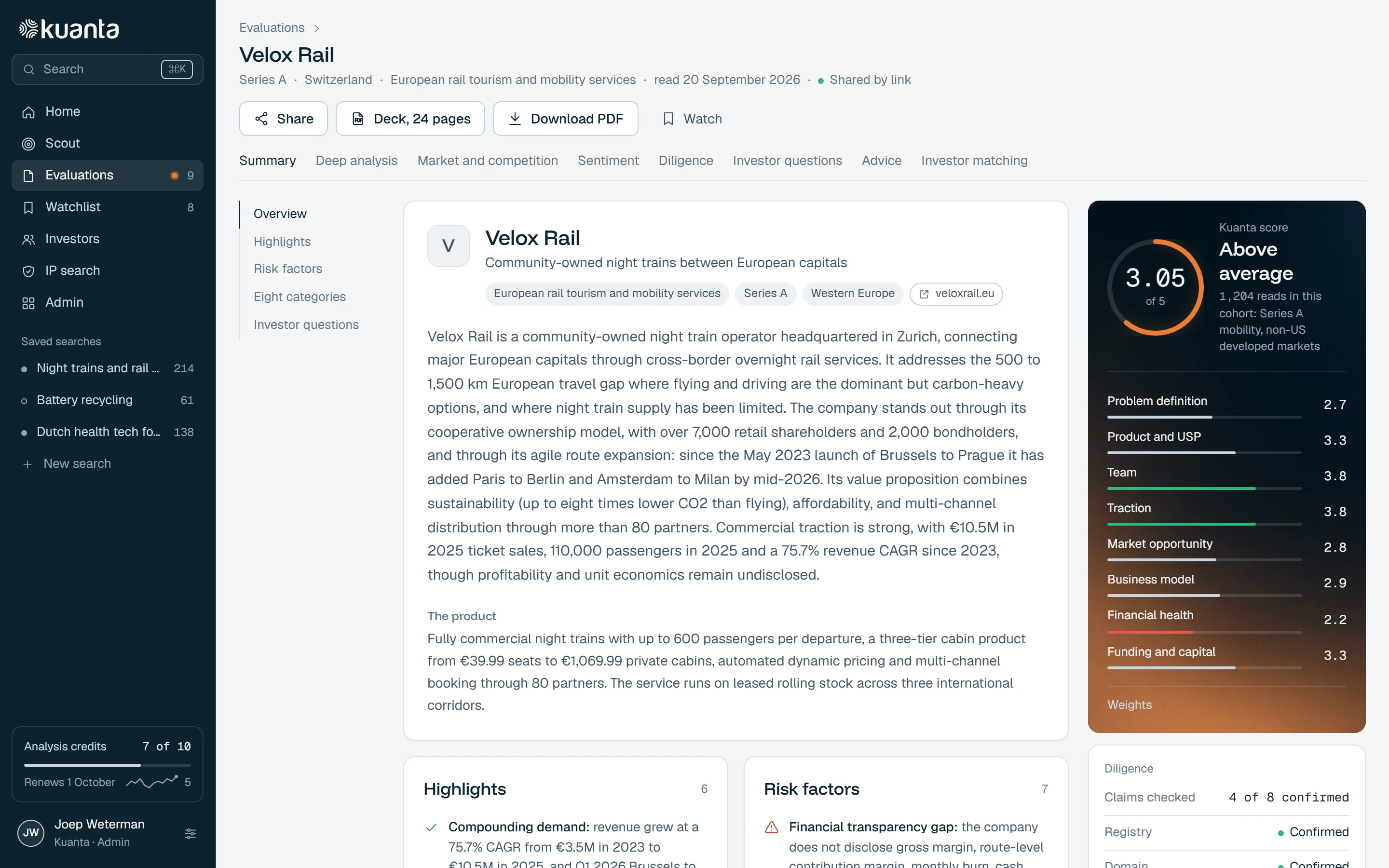
The summary of a Kuanta evaluation report for Velox Rail: the read, highlights, risk factors and the score card

Executive summary

One page for the partner meeting, with the scores, the red flags and how the startup compares with its peers.

Score summaryRed flagsSpider chartVerdict

Full report

The complete analysis behind every score, with each verified figure, the competitive landscape and the questions to raise with the founders.

Deep narrativeVerified metricsCompetitor matrixCited sources

Most startups are judged on the deck alone.

There's rarely time to look further, so the same startup can get a very different verdict depending on who reads it.

Claims without proof

A deck shows a company at its best. Without the filings and the numbers behind it, you're investing in a story.

TechNova pitch deck, audited
“20 percent monthly revenue growth”EUR 142K ARR verified
“80 percent gross margin”P&L shows 45 percent after server costs
“23 enterprise customers”0 paying; all 23 are beta testers
2 discrepancies in the narrative

Scored on the wrong criteria

A hardware startup and a SaaS company succeed for different reasons, and a generic scorecard misses what each is really judged on.

One checklist for every vertical
Deep tech and hardwareManufacturing readinessTRL 6 validated
Clinical biotechRegulatory pathwayEMA fast track
Enterprise B2B SaaSNet retention and CAC114 percent NDR
Misses what each vertical is judged on

Deep dives don't scale

When a proper analysis takes an analyst days, only a fraction of the deal flow ever gets one. The rest is decided on the deck.

An analyst40 hper deck4 percent of the pipeline gets a deep dive
Kuantaminper deckThe whole pipeline, with the audit trail attached

What changes in practice.

Before

Hours of work per deck, with results that depend on who does it.

Half a day or more for a first proper look at each startup
No fixed framework, so every assessment turns out differently
Competitors and market data tracked down by hand
Memos that vary in depth from one analyst to the next
With Kuanta evaluation

Every source attached and every score explained.

A full analysis ready within minutes
Claims checked against filings and public records
Every startup benchmarked against its real competitors
The same depth and structure in every report

Three steps from deck to score.

Pitch deck or business plan

Required

Upload in any common format.

PDFPPTXDOCXXLS

Supporting documents

Optional

Add data room files, market research, financial models or a cap table for a deeper analysis.

Data roomCap table
Founder checkMarket signalsPatents and IPGovernment registryFunding dataSocial and web0.00
Diligence
Claims checked
4 of 8 confirmed
Registry
Confirmed
Domain
Confirmed
Red flags
2

Collect

We structure what you've shared and cross-reference it with public records and live market data before the analysis begins.

Verify

Specialist agents each take one part of the analysis and back their findings with evidence, before the results are brought together.

Benchmark

Each score is weighted by what matters in the startup's industry, compared with similar companies and read against your investment thesis.

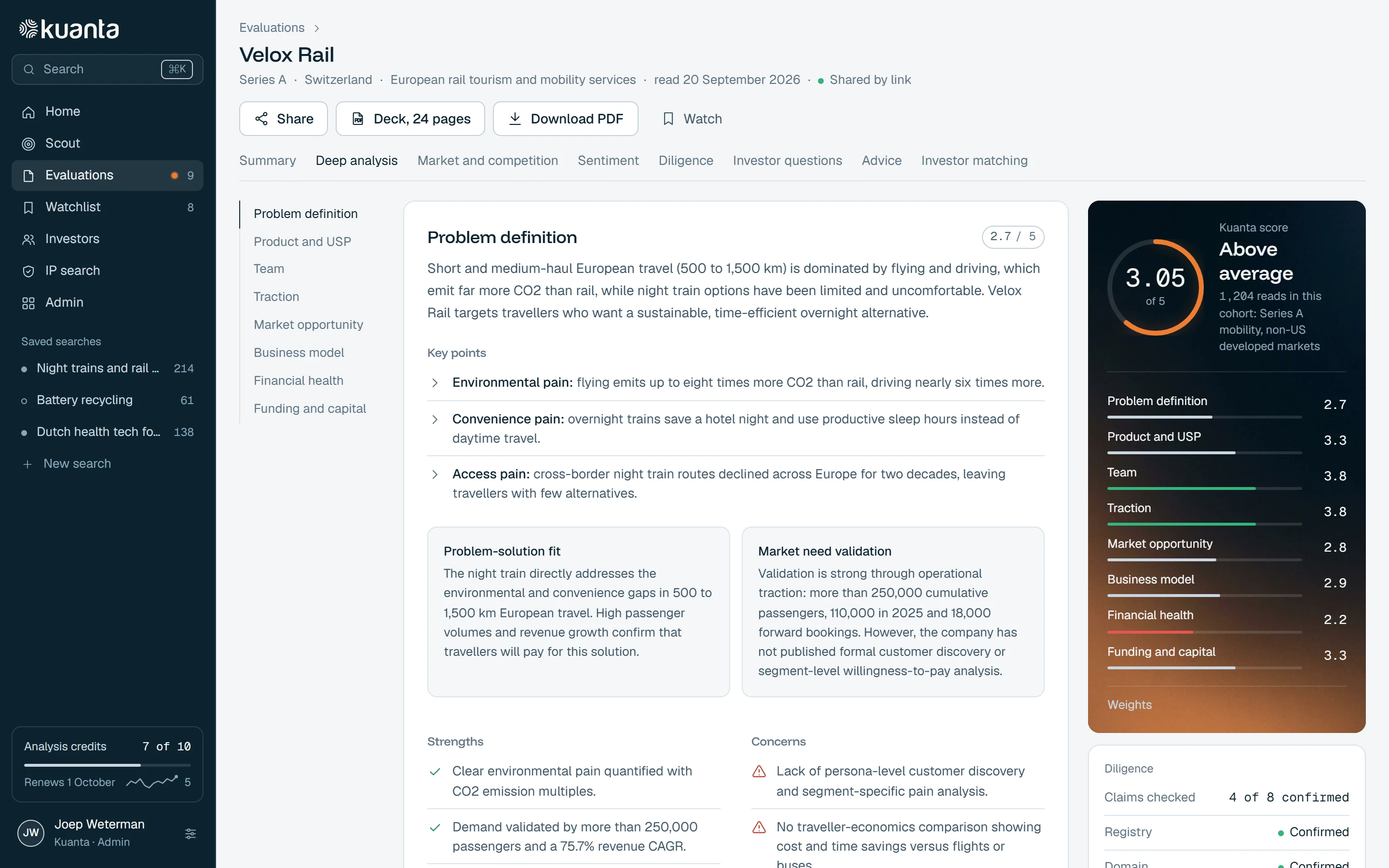
The deep analysis tab of a Kuanta report: the problem definition scored 2.7 out of 5 with its reasoning, beside the score card

What every startup is assessed on.

Five areas apply to every company, and five more are weighted by what matters in its industry. Each has its own criteria and its own set of peers.

For every company

Team and foundersBackgrounds, track record, domain depth and founder-market fit.
Market opportunityTAM and SAM sizing, market timing, structural tailwinds and entry dynamics.
Business modelRevenue architecture, unit economics, pricing logic and scalability signals.
Product and technologyTechnical differentiation, build depth, IP defensibility and roadmap credibility.
Traction and metricsRevenue, growth rate, retention, engagement and leading indicators.

Weighted by industry

Competitive landscapeLive competitor mapping, positioning gaps and how durable the differentiation is.
Customer and go-to-marketIdeal customer definition, channel strategy, sales motion and acquisition logic.
Financial healthRunway, burn discipline, forecast assumptions and capital efficiency.
Use of fundsWhat the round pays for, in what order, and the milestone it has to reach.
Operational readinessTeam structure, execution evidence, process maturity and scaling risk.

Every industry is judged differently.

Each framework is built around what experienced investors look for.

6domains
24verticals
835criteria

Technology & Software

Core digital business models
  • SaaS / Software37 metrics
  • Infrastructure / API21 metrics
  • Marketplace / Platform28 metrics
  • Fintech37 metrics

Deep Tech & Hardware

Capital-intensive, IP-driven models
  • Hardware / Deep Tech28 metrics
  • Defense Tech57 metrics
  • Robotics / Autonomous41 metrics
  • Climate Tech / Clean Energy44 metrics

Life Sciences & Health

Regulated, evidence-driven verticals
  • Biotech / Life Sciences24 metrics
  • Healthtech / Digital Health52 metrics
  • MedTech / Medical Devices38 metrics
  • Pharma & Therapeutics42 metrics

Consumer, Services & Real Assets

Revenue-driven and asset-heavy models
  • Consumer / D2C26 metrics
  • Services / Consulting28 metrics
  • Proptech / Real Estate31 metrics
  • E-commerce & Retail Tech35 metrics

Impact & Emerging

Sector-specific high-growth verticals
  • Edtech37 metrics
  • Agtech / Foodtech37 metrics
  • Mobility / Logistics34 metrics
  • Circular Economy & ESG39 metrics

Frontier & Niche

Specialized verticals for targeted deal flow
  • Islamic / Halal Tech30 metrics
  • SpaceTech / Aerospace25 metrics
  • Web3 / Blockchain28 metrics
  • Quantum & Advanced Computing36 metrics

Tested twice at Rotterdam School of Management.

Two independent studies at RSM, Erasmus University, put the evaluation engine to the test: once against senior judges, once with seventeen VC analysts.

Erasmus University Rotterdam

Kuanta outperformed experienced investors on predicting which startups survive, and matched them on everything else.

Read the research summary (PDF)
2independent studies, 2026
150startups scored by Kuanta and by senior judges
17VC analysts who decided with a Kuanta read in front of them

Our reasoning matches experienced investors.

  1. As accurate as experienced investorsKuanta predicted startup survival and funding odds as accurately as experienced investors scoring the same companies.
  2. Finds more of the eventual winnersVenture returns depend on the outliers. Kuanta identified more of the startups that went on to raise funding than the investors did.
  3. Stronger specifically on survivalOn predicting which startups survive, Kuanta's scoring dimensions outperformed the investors' own.

We shifted the decision-making of 17 VC analysts.

  1. Changed their investment callsWith a Kuanta analysis in front of them, evaluators saw information outside the pitch deck and changed their investment decision because of it.
  2. Increased confidence of analystsWorking with Kuanta's assessment raised how much the analysts trusted their own judgment, the confidence that drives a better call.
  3. Earned trust in the outputIts structure, synthesis and side-by-side comparison earned high trust from analysts, with distrust the rare exception.

Questions and answers.

Everything you need to know about evaluation.

Something else? info@kuanta.ai

Why not just use an LLM to evaluate a startup?

A general AI model tells you what the deck tells it. It doesn't check claims, read live data or compare the startup with its real competitors. Kuanta checks every claim against external sources, applies the framework used in the startup's industry and returns a fully sourced report within minutes.

What is agentic startup evaluation?

Agentic startup evaluation means several specialist AI agents each handle one part of the due diligence, such as checking claims, mapping the market, testing the financial logic and looking for contradictions. Each agent backs its findings with sources before the results are brought together into one scored report.

How does Kuanta deal with hallucinations?

Every claim in an evaluation is checked against external sources, and anything that can't be verified is clearly marked as such in the report.

How are startups from different industries evaluated?

Each startup is evaluated on the framework for its industry. A biotech company is judged on its clinical pipeline, regulatory pathway and IP, and a hardware company on manufacturing readiness, supply chain and unit economics. Kuanta uses 24 industry frameworks with 835 criteria in total.

What does an evaluation report look like?

A report covers team, market, product, financials, traction and risk, with each area scored and compared with relevant competitors. You can download it as a one-page executive summary or as the full report with the analysis behind every score.

Pitch decks are confidential. How is sensitive information handled?

Uploaded documents are processed in an isolated, GDPR-compliant environment in Frankfurt. Decks aren't stored and are never shared or used for training.

Where does the data in an evaluation come from?

Every finding in a report comes with its source, so you can trace and verify each one yourself.

Can evaluations be customized?

Yes. You can adjust how the different areas are weighted in the score, and further customization is available on request.

What do I need to get started?

A pitch deck or business plan for the startup you want to evaluate. Log in at app.kuanta.ai, upload the file, and the report is ready within minutes.

See beyond your next pitch deck.

In fifteen minutes, we'll run a full evaluation with you on a startup of your choice.
Book a demo